

Preparing Formed Bottles for Internal Coating
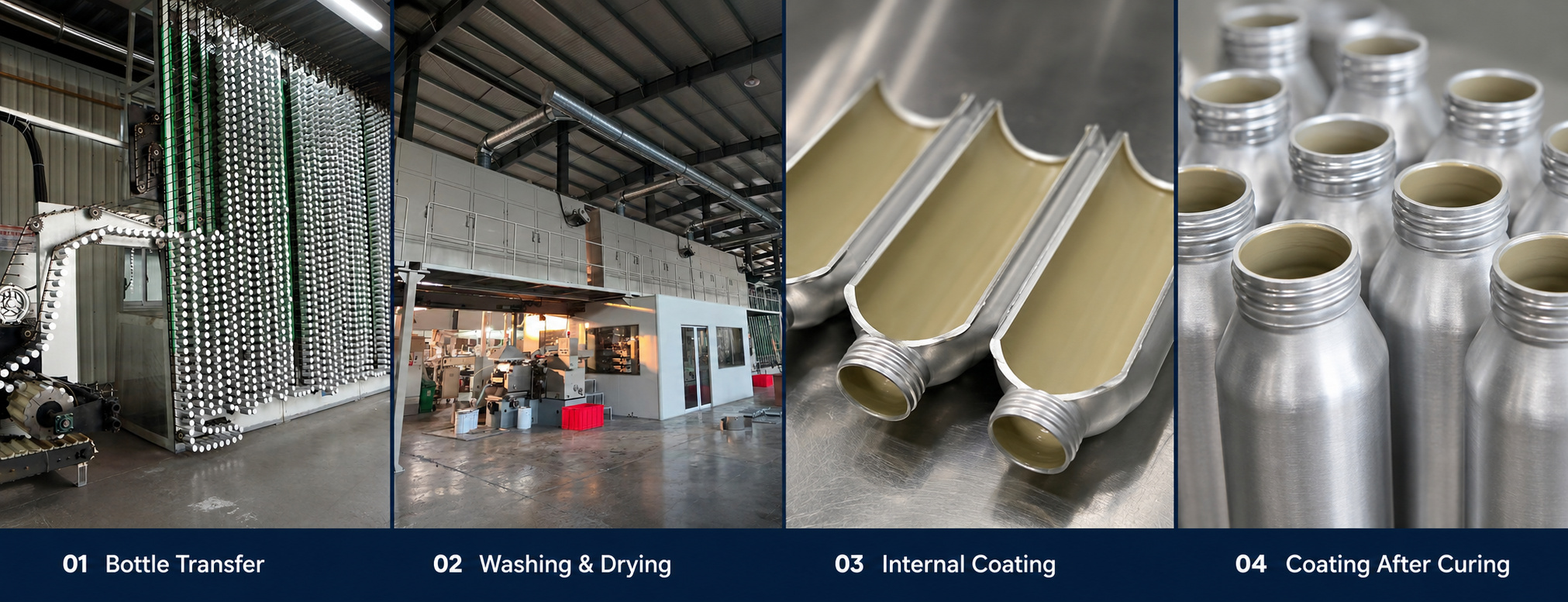
After impact extrusion and trimming, aluminium bottle bodies must be cleaned before an internal coating is applied. Residual lubricant, aluminium particles or other processing contamination can affect coating adhesion and the cleanliness of the finished container.
The formed bottles pass through washing and drying stages under controlled production conditions. Bottles should be sufficiently clean and dry before coating; trapped moisture or surface contamination may cause uneven coverage, poor adhesion or visible coating defects.
This stage follows impact extrusion and trimming and prepares the bottle body for application-specific internal finishing.
 Selecting the Coating Around the Filling Product
Internal coating selection begins with the product that will be filled into the bottle. Cosmetic formulas, personal-care liquids, household products and beverages do not have identical compatibility requirements.
Before recommending a production route, we review the filling product, intended use, bottle size, closure system, destination market and any specified testing requirements. Buyers should provide as much formulation or product-category information as commercially practical. A reference bottle alone is not sufficient for confirming coating suitability.
The coating specification should be reviewed together with the neck and closure because the container must function as a complete packaging system. More information is available on our internal coating and closure matching page.
Where required, third-party compatibility, migration or food-contact testing can be discussed. Testing scope and acceptance criteria should be agreed before the bulk order rather than assumed from appearance alone.
Internal Coating Application
Once the coating requirement is confirmed, the approved coating is applied to the inside surface of the cleaned bottle body. Application must cover the specified internal area consistently without excessive accumulation, missed areas or contamination.
Bottle dimensions, opening size and body shape can influence the coating setup. Deep or narrow bottles may require different production adjustments from wider bottle formats. These factors are reviewed during sampling and process preparation.
Coating colour may vary according to the selected system and application. Its appearance should not be treated as the only quality indicator; coverage, curing condition and agreed functional requirements are more important for procurement approval.
Oven Curing and Process Control
After application, the coated bottles pass through curing equipment. The coating must receive the required heat exposure to form a stable internal layer. Insufficient or inconsistent curing can affect adhesion and subsequent packaging performance.
Production settings depend on the specified coating system, bottle format and line conditions. Bulk production should therefore follow the confirmed specification and approved sample rather than a general setting used for every aluminium bottle.
Process records and in-line observations help identify abnormal colour, incomplete coverage or other visible coating issues before the bottles move to external finishing and printing.
 Sample Approval Before Bulk Production
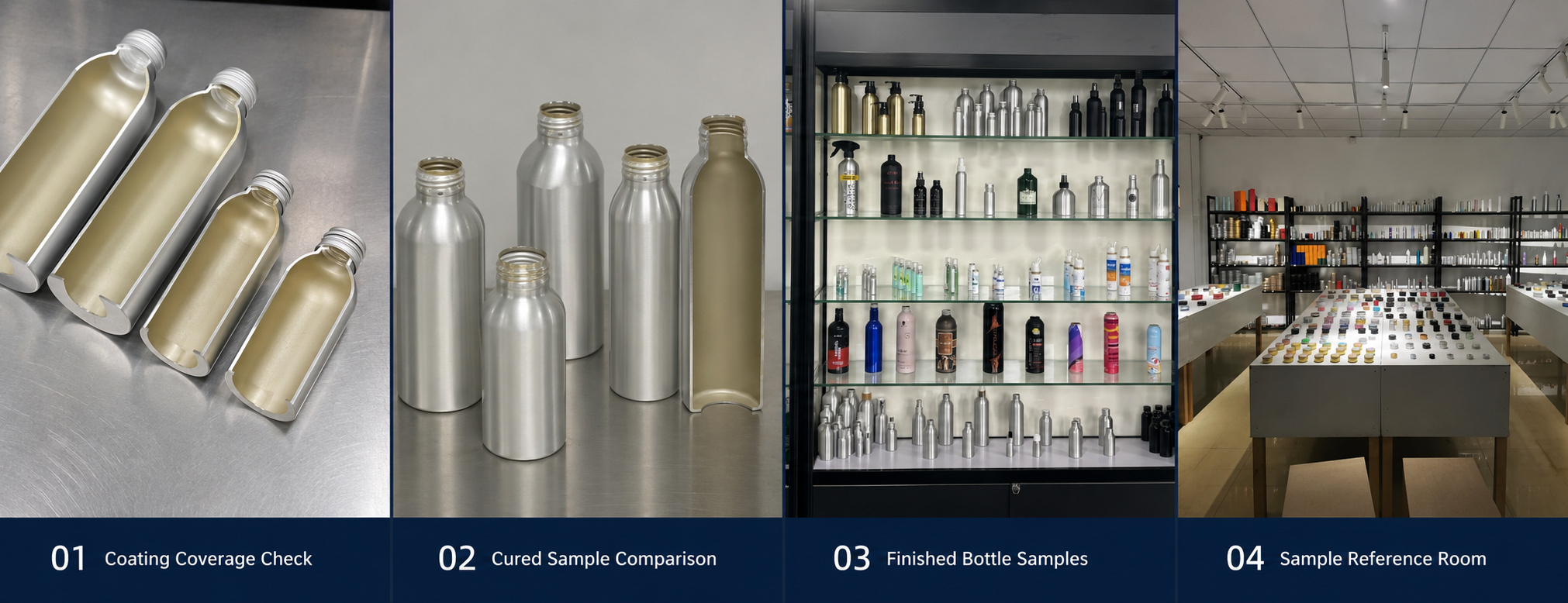
For an OEM project, the sample review should confirm more than bottle colour and logo. Buyers should check the bottle model, capacity, internal coating, neck specification, closure fit and overall appearance as one approved packaging specification.
If filling-product compatibility is critical, the buyer or appointed laboratory should complete the necessary filling or compatibility evaluation before mass production. Any approved test conditions should be documented clearly so they can be referenced during repeat orders.
Changes to the formula, coating, bottle size or closure after approval may require another review and can affect sample time, MOQ, cost and production scheduling.
Inspection Before the Next Production Stage
Coated bottles are checked for visible coverage, contamination, surface condition and consistency with the confirmed requirement. Additional checks or third-party testing can be arranged when specified in the purchase agreement.
After coating and curing approval, bottles proceed to external colour finishing, printing, neck forming, closure matching and final inspection. Our quality control and leak testing process covers the later dimensional, closure, appearance and packing checks.
For an accurate quotation, send the filling product, bottle capacity, required quantity, closure type, destination market and applicable testing standard. These details allow us to evaluate the coating route, sample requirements, practical MOQ and bulk-production lead time.