

Start with the Required Packaging Specification
Bottle development begins by confirming what the packaging must achieve, rather than copying the appearance of a reference bottle. Aluveriq Packaging reviews the filling product, required capacity, bottle dimensions, neck, closure, order quantity and destination-market requirements before recommending an existing model or new tooling.
This service is intended for packaging importers, distributors, private-label brands, cosmetic and personal-care companies, and selected beverage packaging projects requiring repeat bulk production.
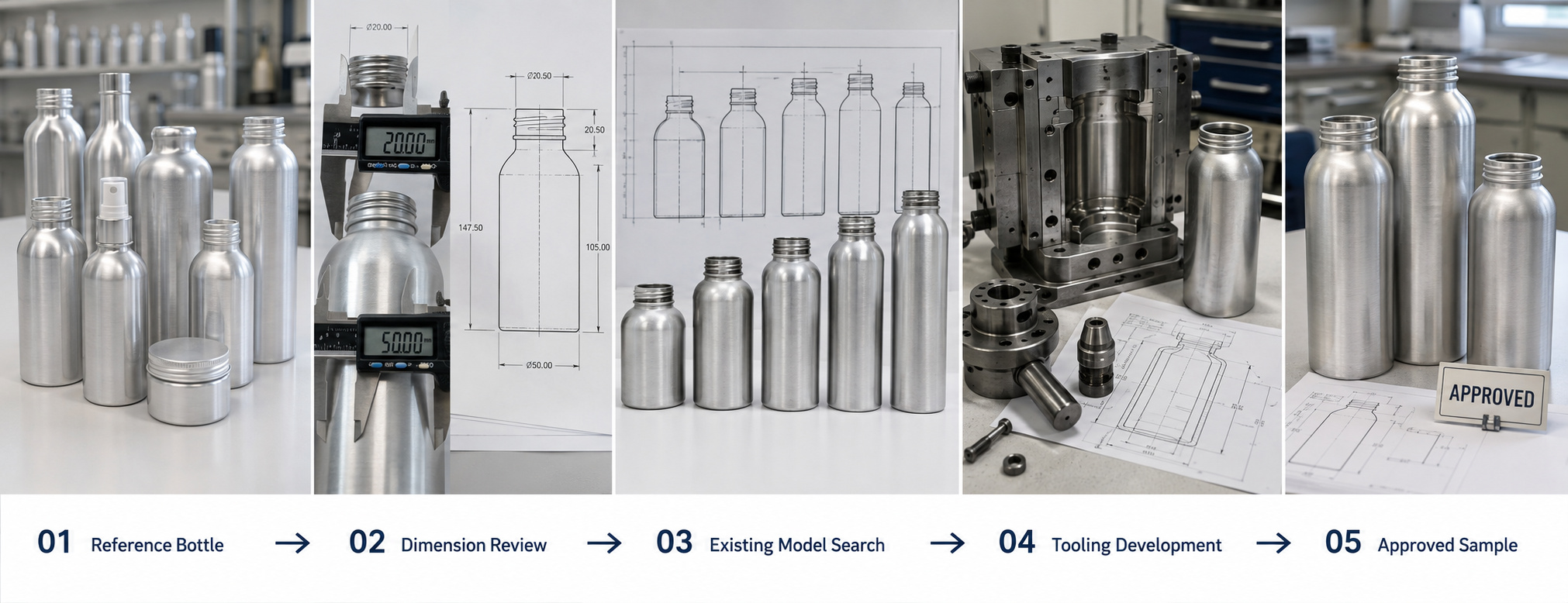 Existing Bottle Model Review
An existing bottle model is checked first because it can reduce tooling investment, sampling time and practical MOQ. A suitable model may still be customized with an approved internal coating, cap, pump, sprayer, colour, printing and packaging.
During model comparison, we review:
- Nominal filling capacity
- Bottle height and outside diameter
- Shoulder shape
- Neck opening and thread
- Closure compatibility
- Available internal coating
- Required decoration area
- Packing and filling-line considerations
A model should not be selected by capacity alone. Two bottles with the same nominal volume may have different diameters, shoulders, necks and closure requirements.
Bottle Size and Shape Confirmation
When the buyer has a specific size requirement, the main dimensions should be clearly defined. These normally include bottle capacity, overall height, body diameter, neck diameter and the required shoulder profile.
A technical drawing is preferred. A clear physical reference sample can also be used for initial evaluation, but it does not replace an approved drawing. The final specification must identify measurable dimensions and tolerances that can be checked during sample development and bulk production.
Buyers requiring coordinated internal coating and dispensing components should also review Internal Coating & Closure Matching before the bottle structure is finalized.
When New Tooling Is Required
New tooling may be evaluated when no existing model can meet the required:
- Capacity
- Diameter or height
- Bottle shoulder
- Neck structure
- Thread specification
- Overall profile
- Closure combination
Tooling feasibility depends on the aluminium forming process, bottle geometry, neck requirements and expected order volume. Not every reference shape can be reproduced without structural adjustment.
The proposed design is reviewed before tooling begins. Where necessary, dimensions may be modified to improve forming stability, neck consistency, closure fit or bulk-production reliability.
Tooling and Sample Development
A new-tooling project normally follows these stages:
- Confirm the application and required dimensions.
- Review the drawing or physical reference sample.
- Evaluate forming and neck requirements.
- Confirm tooling cost, MOQ and development time.
- Produce initial bottle samples.
- Check dimensions, shape and neck structure.
- Match the required closure.
- Approve the production sample and written specification.
New-tooling samples typically require approximately 20–30 days, depending on bottle structure and development requirements. This timeframe begins after the technical details and tooling arrangement are confirmed.
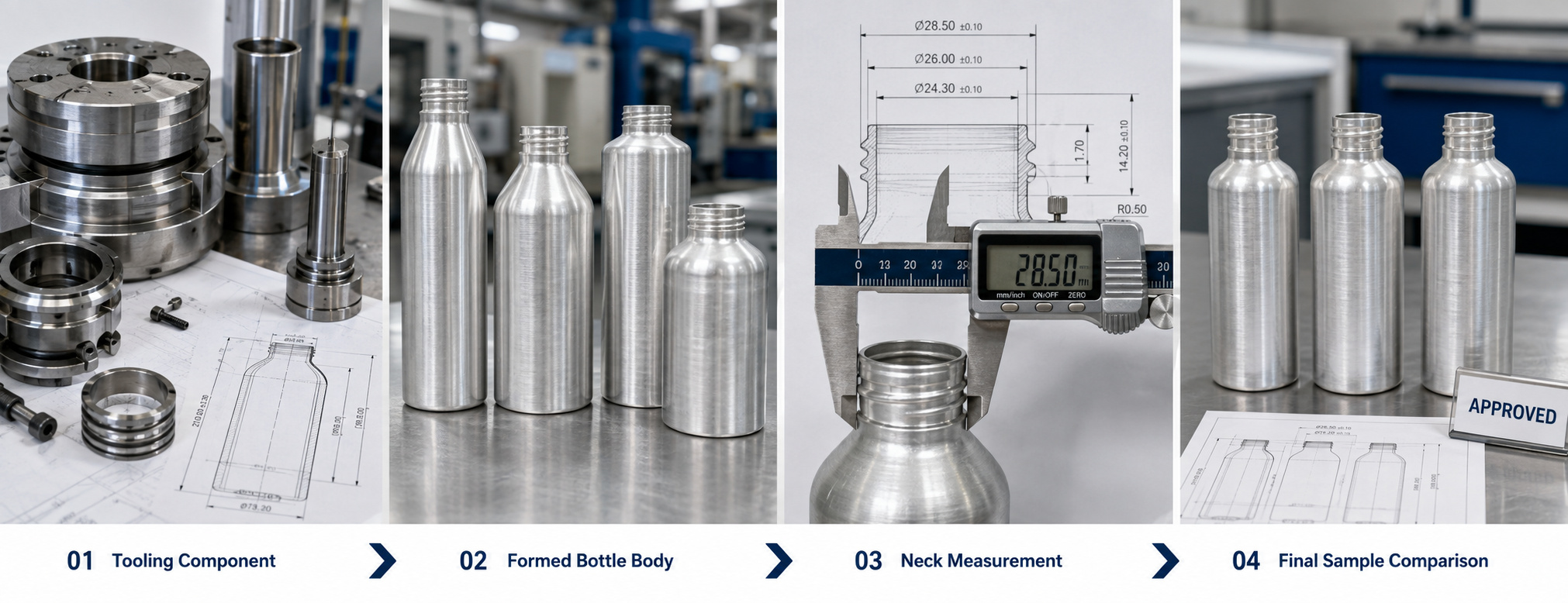 Pre-Production Sample Approval
Before bulk production, the buyer should approve more than the bottle’s general appearance. Confirmation should cover:
- Capacity and critical dimensions
- Bottle profile and shoulder shape
- Neck and thread dimensions
- Closure fit
- Internal coating requirement
- Surface finish and decoration area
- Final sample appearance
- Packing method
The approved sample and technical specification become the production reference. Bottle dimensions and neck formation are then checked during manufacturing and final inspection. Relevant forming steps are explained under Impact Extrusion & Trimming.
MOQ, Lead Time and Quotation Information
Typical MOQ is approximately 5,000–20,000 pieces, but new tooling or a special bottle structure may require a higher quantity. Mass production normally takes about 25–40 days after the sample and specification are approved.
For evaluation, provide the filling product, required capacity, target dimensions, neck and closure, estimated quantity, drawing or reference sample, decoration requirements and destination country. These details allow us to compare existing models, assess new tooling and prepare a practical development proposal.